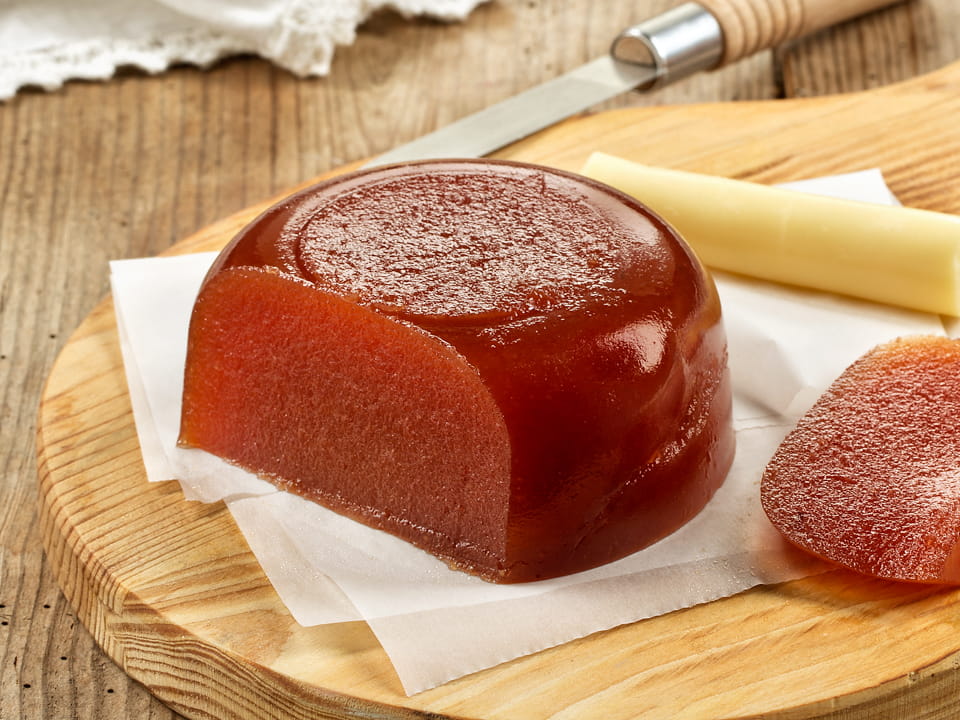
The English word marmalade comes from marmelada, the Portuguese word for quince paste, not orange jam. Portuguese cooks were boiling down marmelos (quinces) into thick sweetened paste centuries ago, and a slab wrapped in wax paper in the pantry, ready to slice alongside a hard cheese, is still a fixture of Portuguese homes.
Quince is a strange fruit if you have never worked with it, hard as a potato and too astringent to eat raw, but simmer it low and slow with sugar and lemon and it turns a deep rosy amber and becomes something between a jam and a candy. Poured into a mold and left to set, it firms up enough to slice into neat little wedges, which is exactly how it is meant to be served, next to cheese, never spread like jelly.
It is a good early-fall project, when quinces appear at farmers markets, and it keeps for months.
Pair it with a firm sheep’s milk cheese the way we do with Queijadas de Sintra (recipe on the site) for dessert, or set it out on a cheese board next to a Spanish-style quince paste for a fun side-by-side tasting, since the two countries’ versions are cousins but not identical.
Marmelada Portuguesa Recipe
Ingredients
- 3 lbs quinces (about 5-6 medium)
- 3 cups water, plus more as needed
- 2 1/2 cups granulated sugar (roughly equal weight to the cooked quince pulp)
- Juice of 1 lemon
- 1 cinnamon stick, optional
Instructions
- Rinse the quinces well to remove their fuzzy coating. Quarter, core, and roughly chop them; there is no need to peel.
- Place the chopped quince in a large pot with the water, enough to just cover. Bring to a boil, then reduce heat and simmer, covered, for 30-40 minutes, until completely soft.
- Drain the quince, reserving a little of the cooking liquid, and let cool slightly. Puree in a food processor or pass through a food mill until smooth, adding a splash of the reserved liquid if it is too thick to blend.
- Weigh the puree and measure out an equal weight of sugar (or use roughly 2 1/2 cups sugar for this quantity).
- Return the puree to a clean, heavy-bottomed pot with the sugar, lemon juice, and cinnamon stick if using. Cook over medium-low heat, stirring often, for 40-50 minutes.
- The paste is ready when it has turned deep amber-pink and a spoon dragged across the bottom of the pot leaves a clear trail for a second or two before the paste flows back.
- Remove the cinnamon stick. Pour the hot paste into a parchment-lined loaf pan or shallow dish, smoothing the top.
- Let cool uncovered at room temperature, then cover and let set overnight before turning out and slicing into wedges.
Enjoy our recipes? Add Maria’s Cookbook as a preferred source on Google to see more of our content in your search results.