
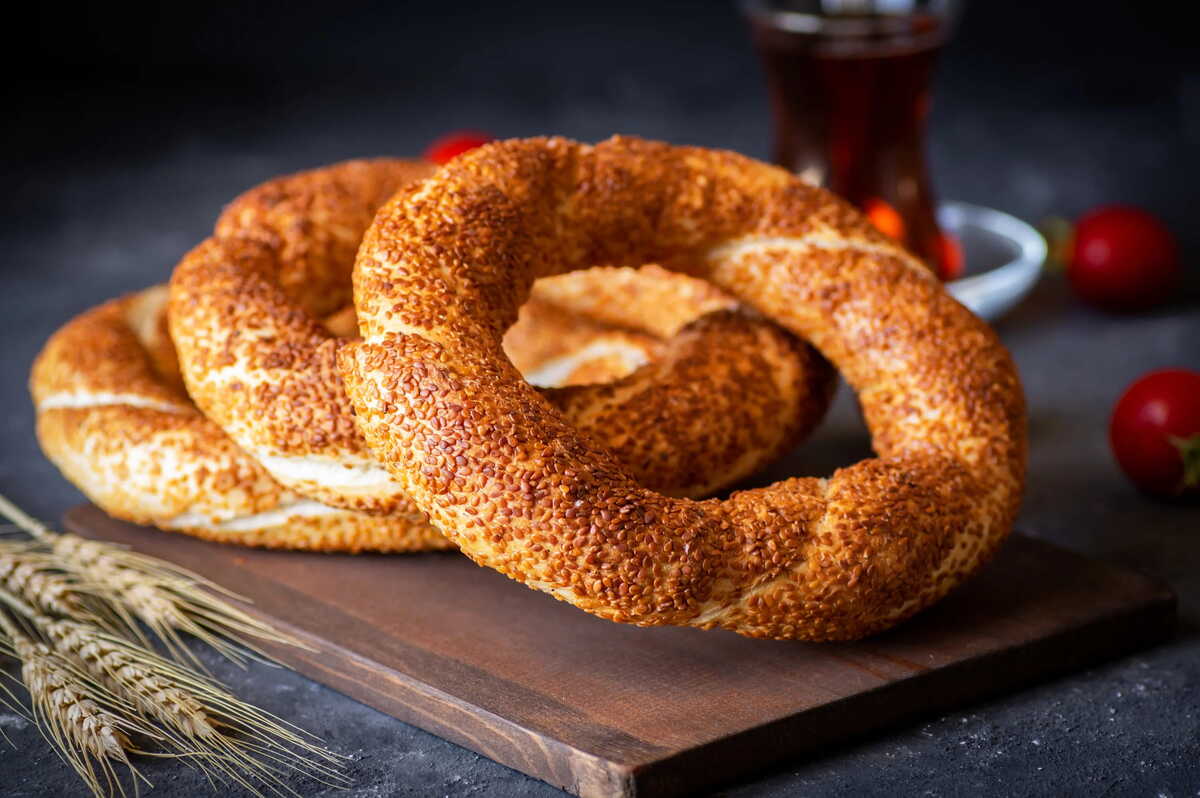
Lucas has strong opinions about bread, and somewhere around the third day of a trip to Istanbul two summers ago, he declared simit better than any Portuguese pao we have ever bought together, which is the kind of betrayal I have chosen to forgive because, honestly, he is not wrong. Simit are the sesame-crusted bread rings sold from red carts on seemingly every corner in Turkey: twisted, dipped in grape molasses, rolled thick in sesame seeds, and baked until the crust turns dark and shatteringly crisp around a soft, chewy inside.
The dough itself is a simple, straightforward yeasted bread, nothing exotic there. What makes simit taste like simit is the molasses dip before baking, traditionally pekmez, a thick grape syrup that gives the crust its deep color and faint fruity edge, and helps the sesame seeds toast into something nuttier and darker than a plain sesame bagel ever gets. Twisting two ropes of dough together before shaping the ring also gives it that distinctive spiral texture, with lots of nooks for the seeds to cling to.
Grape molasses is not something I keep on hand for Portuguese cooking, so I buy a bottle specifically for this recipe and it lasts a good long while. If you enjoy this kind of chewy, well-seasoned Mediterranean bread, my Manakish Za’atar and Msemen (recipe on the site) are two more flatbreads worth a weekend baking project, and simit make a lovely surprise addition next to a plate of my own Bolo do Caco (recipe on the site) if you ever want to put two very different bread traditions on the same table.
Simit Recipe
Prep time: 1 hour 30 minutes (includes rising and resting) · Cook time: 20 minutes · Total: 1 hour 50 minutes · Servings: 8 simit · Calories: ~260 per serving
Ingredients
- For the dough:
- 1 cup warm water (about 110F)
- 2 1/4 teaspoons (1 packet) active dry yeast
- 1 tablespoon granulated sugar
- 3 1/2 cups all-purpose flour, plus more for kneading
- 1 teaspoon salt
- 2 tablespoons vegetable oil
- For the coating:
- 1/2 cup grape molasses (pekmez), or substitute 1/3 cup regular molasses mixed with 3 tablespoons honey
- 1/2 cup warm water
- 1 1/2 cups raw sesame seeds
Instructions
- In a small bowl, stir together the warm water, yeast, and sugar. Let sit for 5 to 10 minutes, until foamy.
- In a large bowl, whisk together the flour and salt. Make a well in the center, pour in the yeast mixture and vegetable oil, and mix until a shaggy dough forms.
- Turn the dough onto a floured surface and knead for 8 to 10 minutes, until smooth and elastic. Place in an oiled bowl, cover, and let rise in a warm spot for about 1 hour, until doubled in size.
- Punch down the dough and divide it into 8 equal pieces. Roll each piece into a long rope about 20 inches long, then fold in half and twist the two strands together into a spiral rope. Bring the ends together to form a ring, pinching to seal.
- In a shallow dish, whisk the grape molasses with the warm water. Spread the sesame seeds on a separate plate or tray.
- Dip each dough ring into the molasses mixture, coating both sides, then press into the sesame seeds, turning to coat generously all over.
- Place the rings on parchment-lined baking sheets, spaced apart, and let rest for 15 to 20 minutes while the oven preheats to 425F (220C).
- Bake for 18 to 20 minutes, until deep golden brown and firm.
- Cool on a wire rack for at least 10 minutes before serving. Simit are best the day they are baked, split and eaten plain, or with cheese, olives, or jam.
Recipe Notes
- Grape molasses (pekmez) is what gives simit its color, shine, and slightly fruity depth; look for it at Middle Eastern or Turkish grocery stores, or order it online. Regular molasses mixed with honey is a reasonable stand-in but tastes a little more bitter and less fruity.
- Do not skip the resting step after shaping; it relaxes the gluten and keeps the rings from shrinking back in the oven.
- Simit go stale quickly once cut, like a good baguette; freeze extras the same day and re-crisp them in a hot oven straight from the freezer.
- Traditionally eaten with tea, alongside soft white cheese, olives, and tomatoes for a full Turkish breakfast spread.
Enjoy our recipes? Add Maria’s Cookbook as a preferred source on Google to see more of our content in your search results.