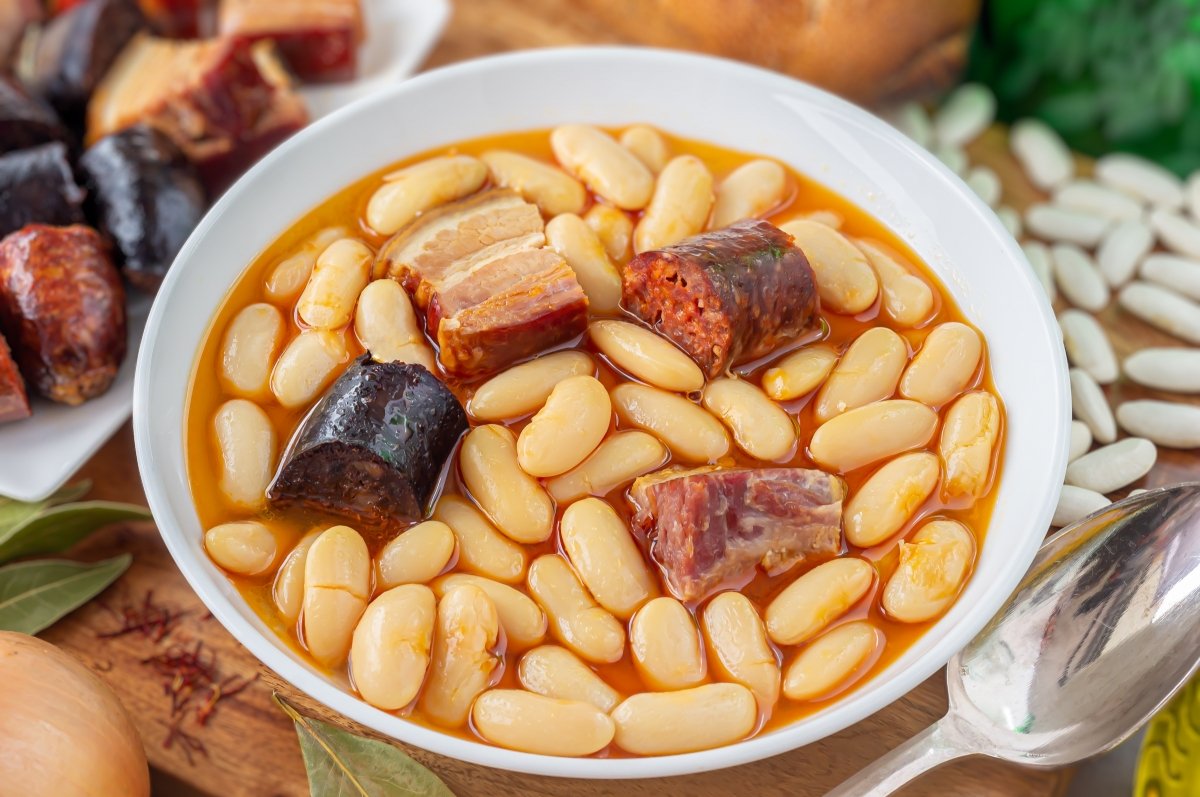
Northern Spain and northern Portugal share a border and a real weakness for a slow-cooked pot of beans and pork, so fabada asturiana will feel familiar to anyone who knows the bean stews of Trás-os-Montes. It is built on fabes, enormous, tender white beans grown in Asturias, simmered for hours with chorizo, morcilla and cuts of pork until the broth turns rich and almost creamy without any cream.
The technique has one famous quirk: Asturian cooks talk about asustar las fabes, scaring the beans, which means adding a splash of cold water partway through the simmer to shock them and keep their skins from splitting. It is not superstition: skip it and you risk a pot of bean mush instead of intact, silky beans.
This is a stick-to-your-ribs dish for a cold day, closer in spirit to our own Butelo com Casulas or Cozido à Portuguesa (both on the site) than to anything light and summery. Serve it in wide bowls with good bread and nothing else, it does not need a side dish, it needs a nap afterward.
Fabada Asturiana Recipe
Ingredients
- 1 lb dried large white beans (fabes if you can find them, otherwise corona or large gigante beans), soaked overnight
- 8 oz Spanish chorizo (cured, not fresh), whole or in large pieces
- 8 oz morcilla (Spanish blood sausage), whole (fully cooked, see note)
- 8 oz smoked ham hock or a chunk of smoked pork shoulder
- 4 oz slab bacon or salt pork, in one piece
- 1 small onion, whole and peeled
- 4 garlic cloves, peeled and left whole
- 1 bay leaf
- A generous pinch of saffron threads (or 1/2 teaspoon sweet paprika as a substitute)
- 2 tablespoons olive oil
- Salt, to taste
- Water, enough to cover generously (about 8 cups)
Instructions
- Drain the soaked beans and place them in a large, heavy pot. Add the chorizo, ham hock, and bacon (hold the morcilla back for now, it can fall apart if it simmers too long). Add the whole onion, garlic cloves, and bay leaf.
- Cover everything with about 8 cups of cold water, and drizzle in the olive oil. Bring to a very gentle boil, skimming off any foam that rises.
- Reduce heat to the lowest simmer, cover partially, and cook 1.5 hours, checking occasionally. If the beans look like they are about to boil hard, scare them, add about 1/2 cup of cold water to bring the temperature down gently. Do not stir with a spoon, instead shake the pot gently by the handles to keep the beans from breaking.
- After 1.5 hours, add the morcilla and the saffron (crumbled between your fingers first). Continue simmering gently, uncovered now, for another 45 minutes to 1 hour, until the beans are tender and the broth has thickened slightly.
- Remove the meats, slice the chorizo, morcilla, bacon, and shred or slice the ham hock meat. Return everything to the pot, or arrange over the beans in the serving dish.
- Season with salt to taste, remembering the meats already bring a lot of seasoning. Let the stew rest for 10 minutes before serving, it improves as it sits.
Enjoy our recipes? Add Maria’s Cookbook as a preferred source on Google to see more of our content in your search results.